
Design in process: Japanese-inspired setting

The process was for the preparation of starting a west march campaign with Rōnin hack.
The first thing to start in 2025 was to run a Japanese-inspired setting. Before the new year went out in a big bang, I decided to run a oneshot, Rōnin by Slightly Reckless Games. While its predecessor is Mörk Borg, it was fun with some minor challenges to reframe how a Japanese-inspired setting is described.
This process is insightful for me, even as an Asian. Since I never have had a chance to discuss with other Asians who use sign language or are familiar with Deaf culture, I debated if I should be considerate of Japanese culture or let its module show me its story.
With that in mind, I decided to look up some materials that are plentifully available everywhere and get some ideas how I can narrate them to reflect the Japanese inspiration. Then I reframed the bowing etiquette [1] that we are not required to read the proper guidelines nor know how to bow. This is to avoid perpetuating the incorrect use of bowing that might disrespect Japanese people because on my table, we use sign language to express ourselves in a clear communication, which in turn, we rely on the visual information.
After I ran an oneshot, I did get some ideas on how to refine my storytelling techniques after seeing the implementation of Rōnin. The first thing is bowing etiquette and Japanese words. I reframed them as optional because I wanted to be cautious about it and I personally like to fact-check with someone who is deaf and Japanese [2] for their sign language. Given no resources available, I re-emphasized that we are not required to know Japanese culture, including etiquette unless I mentioned it in the oneshot session. The reason is, Japanese materials are visually evocative and it is so easy to recreate what they look like in potentially inappropriate ways. Instead, I encouraged my players to learn more about the world provided by my team over the scrutiny of the cultural highlights.
With that in mind, my team and I kicked off with a west march campaign using Rōnin to host some series of oneshots. My goal behind it was to have fun in a different setting, moving away from the eurocentric fantasy games, but also challenge myself to be able to describe the scenes well. The description of scenes was what forced me to learn how to carefully craft words that carry a strong spiritual aspect of Japan during the Kawakura era (1185-1333).
Kawakura era does require more research (still WIP), which I probably won’t be publishing some oneshot adventures after this campaign. After all, the Kawakura era is less popular than the Heian and Edo periods and I plan to work with my team’s friend who lives in Japan for culture consultancy. Their insights were helpful to learn that I need to make my position more clear for future cultural games.
Currently, I used this phrase, “Japan as seen from America” which was suggested by the friend prior to kicking off the west march campaign. The phrase is a good addition to inform Japanese people about our perspective of their culture as Americans and increase more awareness for them to recognize the widespread interpretation of their culture globally. Before using this phrase for your future games, I strongly encourage making efforts to double check with other Japanese designers who might have been involved in cultural consultancy or RPG design. The friend is only a single person who can’t speak for everyone in the deaf Japanese community and it is solely from their personal viewpoint to help us understand the cultural differences in RPG space. The phrase might be evolving over time once RPG reaches the deaf Japanese community.
When my team and I figured out how to encourage our players to play with respect, I developed an additional player principle for them to read under the assumption that we knew each other well. General player principle points are as follows:
- Let the story guide you. Game Master (GM) sometimes adds in some flavors as a result of their research. Having a dialogue on the table will help avoid perpetuating incorrect or improper demonstration of Japanese culture.
- ASL for Japanese words within the campaign only. Coming up with a sign word is something the table should agree together on, only within the campaign. Using outside of the game is strongly discouraged to give Japanese deaf people an opportunity to come up with.
- Don’t be stereotypical. Please just play the game like you would have done with other fantasy games without saying “X does this because of the anime I saw!” or “Y does some awesome moves from manga so those moves should be allowed because that’s Japanese!”. Doing it might harm Japanese culture further to reinforce the stereotypes.
Some points might come off blunt, but it’s necessarily beneficial to be clear with my players. We don’t do well with vague/ambiguous messages if we don’t understand the main point behind them first. It’s like telling them the details first and the intention last. However, feel free to use those principle points in your games with some adaptations/modifications to fit in your table dynamics better.
I’ll stop here before I dive in the black hole of rambling off my head again. If you have any questions, feel free to reach out to me on Discord - I’ll be around The Lost Bay server.
TLDR points:
- Using a phrase, “Japan as seen from America” in the Japanese-inspired games with a grain of salt
- Research, research, research
- Additional suggestions for the Player Principles
If you would like to support my works or just to enjoy what I write or draw, please consider tipping me for a boba (yes, I love boba!) or buying my games at itch store. These purchases will go to the RPG designing logistics and the web logistics.
Footnotes
[1] Bowing etiquette is a memorable social cue to identify people as Japanese.
[2] Deaf Japanese community is considered marginalized and underrepresented in the RPG space and I don’t think I have seen them flourish in it yet unless I missed someone somewhere. Deaf community might be a marginalized community nationwide, but there are more layers to peel off and understand, which is for another story. If you want to learn more about the Deaf community, check out Rogan Shannon’s past video discussing the accessibility for the Deaf community - great insights!
A small bonus - you might see something similar to this on occasions in my future posts. Enjoy!
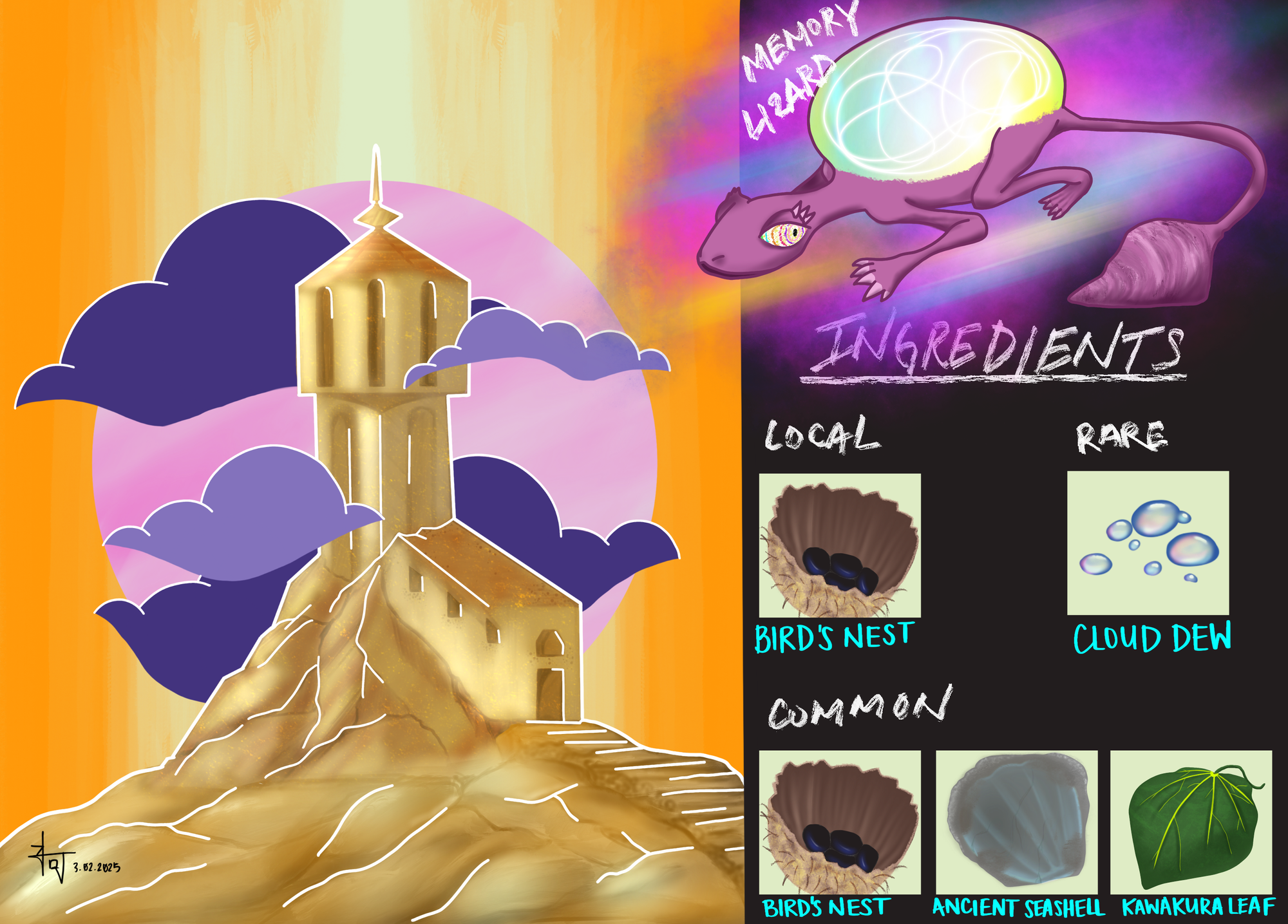
At first glance, fleshed out out of The Last Tea Shop...
A bell tower is sitting on stone, covered in mist, yet reflected upon the mirror.
Memories are carried onto the moving lizards before they vanish in the thin air. Purple mists hover over the bell tower, glittering with glass shards to attract the visitors wandering aimlessly.
No one knows how or when this tea shop got here at first place but an owner with a single purpose: To serve visitors some teas and listen to their tales of the past. The exterior of the bell tower carries no aesthetic identity of its own except the sign banner hanging on the entrance, "Welcome". The words are written in a thick black ink with a few traces of ink-stained drops at the bottom of the banner. Inside the store, some tables with wooden chairs and some pale gray square tablecloth are set up in a grid pattern. Across from the entrance, there is an open kitchen filled with various jars, pastries, and spices. Some jars have particular labels as follows:
- Local ingredient: bird nest fungi
- Common: Ancient seashells, bird nest fungi, and kawakura leaf
- Rare ingredient: Cloud dew
Enter the owner of the store, they tie their long silky hairs up before adjusting their long sleeved robes in preparation of brewing some teas. The scent of the tea begins filling the stable air as the silence envelopes the no-visitor space...